
EU AI Act & AI Governance
Using AI Safely. Stay on top of things.
AI has long been part of many applications, processes, and workflows. But which systems are actually being used, what data do they process, and what requirements apply? OIT promotes transparency, assesses risks, and develops clear guidelines for the safe and responsible use of AI.
WHAT'S IT ALL ABOUT?
Know which AI is being used.
Chatbots, AI assistants, automated processes, or generative tools: AI is used in many areas today—sometimes without companies or organizations having a complete overview of it.
AI governance provides this overview: What systems are used? What data do they use? Who is responsible? And what rules must be followed?
The EU AI Act makes these issues even more relevant. As of August 2, 2026, the transparency requirements set forth in Article 50, among others, will take effect.
Challenge
AI is spreading faster than the rules governing it.
Employees use various AI tools, departments are implementing new solutions, and data is being processed—all without always having a complete overview.
Solution
Systematically Collect and Evaluate AI Data.
OIT works with you to create an overview of the AI systems in use, their areas of application, and potential risks, and uses this information to develop practical guidelines and processes.
Advantages
Control
Responsibilities are made transparent, risks are identified early on, and employees receive clear guidelines for working with AI.
Compliance Quiz: NIS2 and ISO 27001
Five quick questions on risk management, access control, incident management, backup, and the supply chain reveal how far your company has truly come in terms of NIS2 and ISO 27001—with a concrete assessment of your maturity level.
- Risk Management
- Access Protection (MFA)
- Incident Management (24-Hour Reporting Requirement)
- Backup & Recovery
- Supply Chain
HOW IT WORKS
From the document to the answer.
Connect
Integrate documents, systems, and existing knowledge sources.
Understand
Structure content and make it usable for AI.
Questions
Employees ask questions in natural language.
Replies
The AI provides relevant information and cites the underlying sources.

APPLICATIONS
Make Smart Use of Corporate Knowledge.
Internal Knowledge Search
Ask questions about documents, policies, processes, and internal information.
Onboarding
Help new employees become familiar with processes and company knowledge more quickly.
Support & Service
Make manuals, past cases, and technical information immediately available.
Preserving Knowledge
Capture and preserve experiential knowledge before it leaves the company along with employees.
Noticeable Changes
Immediately
Answers Instead of Searches.
Relevant information is available in seconds—without having to spend time searching through folders and systems.
Scalable
Knowledge available to everyone.
New documents, data sources, and areas of knowledge can be integrated step by step.
Discharge
Fewer recurring questions.
Employees find answers on their own, without having to ask experienced colleagues every time.
Case studies
AI verifies 15,000 emails/hour for mid-sized companies
Track & Trace for pharmacy network
Self-service customer portal
Amelie - Chatbot
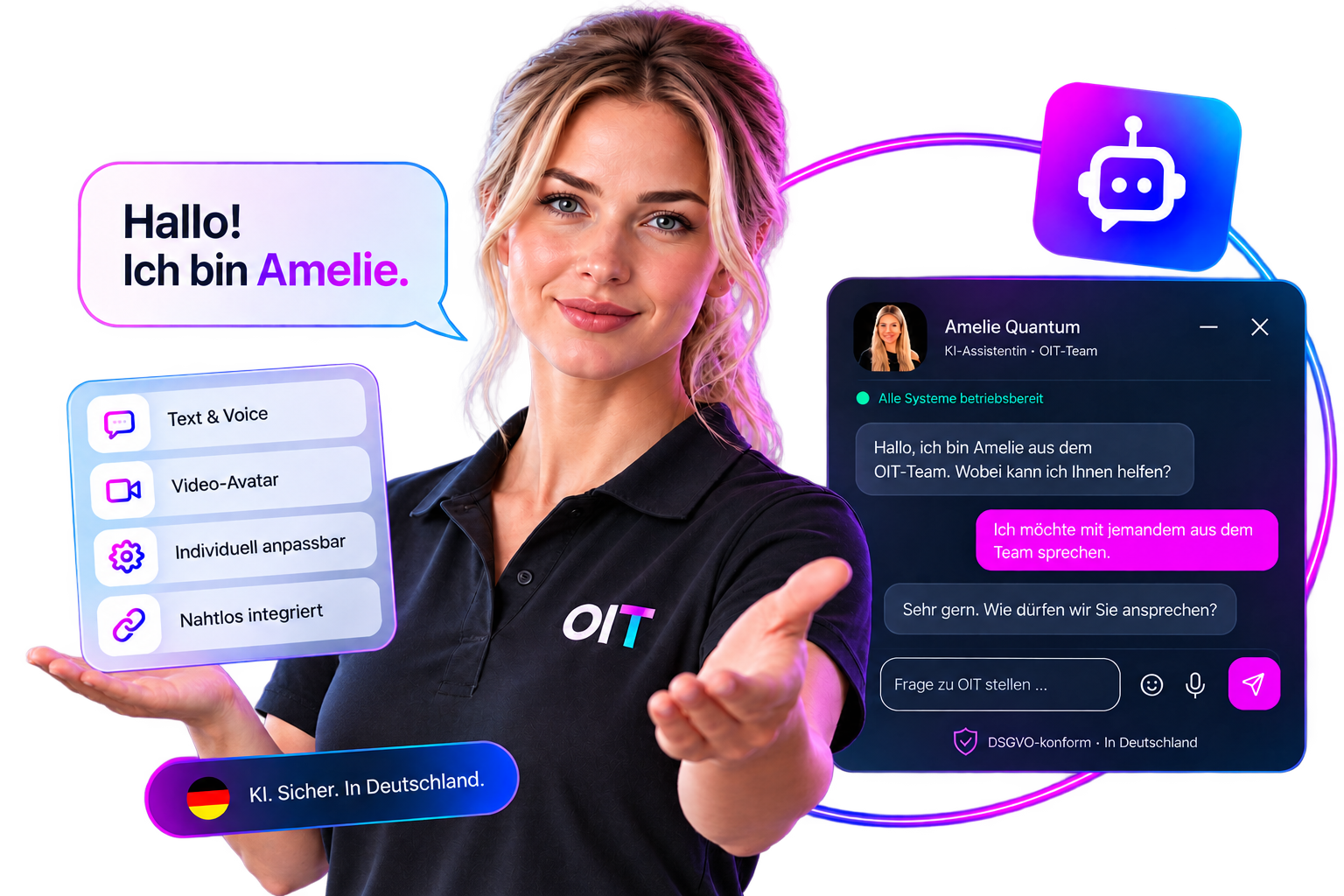
Meet Amelie.
Amelie is more than just a chatbot: She communicates via text, voice, or video, draws on your company's knowledge, integrates with existing systems, and can initiate processes directly.
 German
 English
